
Responsible Gambling
At Grosvenor Casino, we believe that gambling should always be an enjoyable, recreational activity — never a source of stress, financial hardship, or emotional harm. This page exists because we take our responsibility to our readers seriously. Whether you visit us for casino reviews, slot guides, bonus comparisons, or payment method breakdowns, we want every person who uses our platform to gamble safely, within their means, and with a clear understanding of the risks involved.
The United Kingdom has some of the most robust safer gambling regulations in the world, overseen by the UK Gambling Commission. We fully support these standards and encourage all our readers to familiarise themselves with the tools, resources, and support services available to them. Gambling is legal and widely enjoyed across the UK, but it carries real risks — and acknowledging those risks is the first step to staying in control.
If you ever feel that gambling is no longer fun, that you’re spending more than you can afford, or that it is affecting your mental health or relationships, please read this page carefully. Help is always available, and there is no shame in reaching out.
What Responsible Gambling Really Means
Responsible gambling is not simply about placing smaller bets or gambling less frequently. It is a mindset — an ongoing, honest assessment of your relationship with gambling and the impact it has on your life. It means setting clear limits before you start, sticking to those limits even when the urge to chase a loss arises, and treating every gambling session as entertainment rather than a financial strategy.
For most people, gambling remains a harmless pastime. A Friday night casino visit, a flutter on the weekend football, a few spins on a favourite online slot — these are activities enjoyed responsibly by millions across the UK every year. The key difference between recreational gambling and problem gambling often lies not in the activity itself, but in the motivation behind it and the control the person exercises over their behaviour.
Responsible gambling also means understanding the fundamental truth that all forms of gambling are designed with a house edge. No betting system, strategy, or “hot streak” changes this mathematical reality. Every game, slot, or casino product reviewed on our platform carries inherent risk, and long-term profit from gambling is not a realistic expectation for any player.
Recognising When Gambling Stops Being Fun
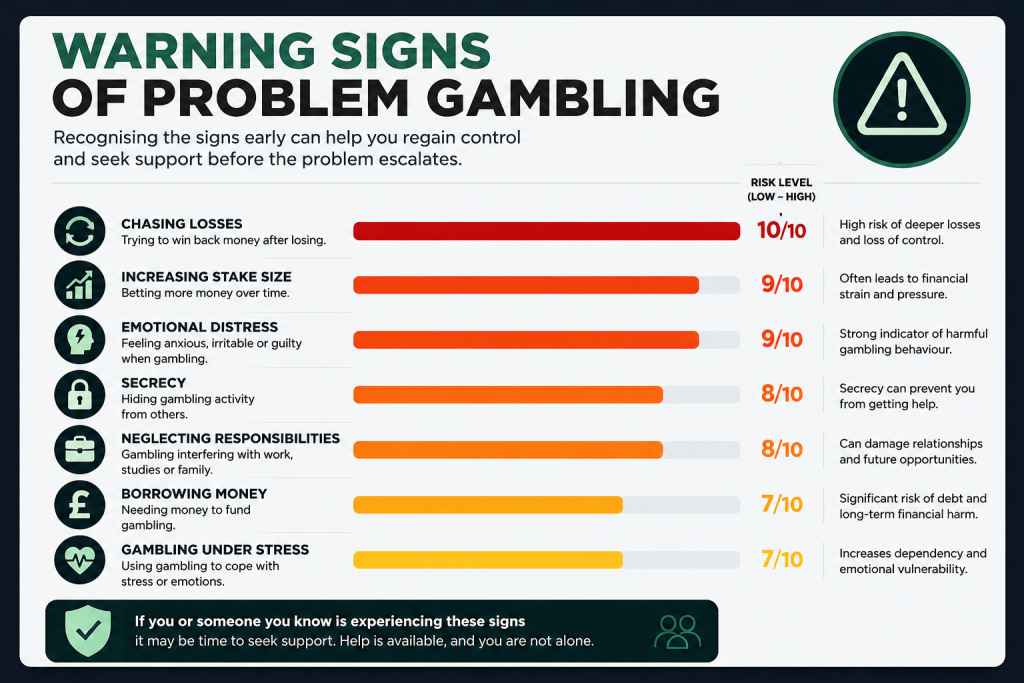
Problem gambling rarely announces itself. It tends to develop gradually, with habits that slowly shift from casual play to compulsive behaviour. Understanding the warning signs — in yourself or someone you care about — is one of the most valuable things you can do.
The following warning signs may indicate that gambling is becoming a problem:
- Spending more money on gambling than you originally intended
- Borrowing money, using savings, or selling possessions to fund gambling
- Feeling irritable, anxious, or restless when unable to gamble
- Thinking about gambling constantly, even during work or family time
- Lying to friends or family about how much time or money you spend gambling
- Chasing losses — continuing to gamble in an attempt to recover money already lost
- Neglecting personal, professional, or financial responsibilities because of gambling
- Using gambling as a way to escape stress, depression, or difficult emotions
- Failed attempts to cut down or stop gambling
- Gambling with money intended for bills, rent, or essential household costs
If several of these resonate with you, we strongly encourage you to speak with a professional or contact one of the support organisations listed further down this page. Identifying the problem early significantly improves outcomes for recovery.
The Emotional Toll of Gambling Harm
Much of the public conversation around gambling harm focuses on money — and financial consequences are real and serious. But the emotional and psychological impact of problem gambling is equally devastating, and often receives far less attention than it deserves.
Shame and secrecy are among the most common experiences for people struggling with gambling addiction. Many individuals hide the extent of their gambling from family and friends for months or years, creating a cycle of isolation that makes recovery harder. The constant pressure of concealment — covering up losses, lying about time spent gambling, managing a double life — creates profound psychological strain.
Anxiety and depression frequently co-occur with gambling addiction. Some people begin gambling to self-medicate these conditions; others develop them as a direct consequence of gambling-related losses and relationship breakdowns. In severe cases, problem gambling has been linked to suicidal ideation. If you or someone you know is in crisis, please contact Samaritans immediately on 116 123 — lines are open 24 hours a day, 365 days a year.
Emotional recovery from gambling harm is a process, not a single event. Rebuilding self-worth, re-establishing trust with loved ones, and developing healthier coping mechanisms all take time. Professional support makes an enormous difference, and the organisations listed in this guide are experienced in exactly this kind of recovery work.
Keeping Your Finances Under Control
Financial damage is one of the most tangible consequences of problem gambling, and one of the hardest to recover from. Gambling-related debt can accumulate rapidly, particularly with easy access to credit, online gambling platforms, and the temptation to chase losses. Establishing clear financial boundaries before you gamble is essential to protecting your long-term wellbeing.
Below are practical steps for maintaining financial control:
- Set a strict gambling budget — decide in advance how much you are willing to spend in a given week or month, and treat that amount as gone once it is spent.
- Never gamble on credit — using a credit card or taking out a loan to fund gambling is one of the clearest indicators that gambling has become a financial risk.
- Separate your gambling funds — keep a dedicated account or e-wallet for gambling activity, entirely separate from your household expenses, savings, or emergency fund.
- Track your actual spending — many people significantly underestimate how much they spend on gambling. Keep a written record to maintain an honest picture.
- Avoid chasing losses — no amount of additional gambling will reliably recover money that has been lost. Accepting a loss and walking away is always the financially sound decision.
- Review your spending regularly — monthly check-ins on your gambling expenditure help you spot concerning patterns before they escalate.
If you are already experiencing gambling-related debt, organisations such as GamCare can connect you with specialist financial counsellors who understand the specific challenges of gambling debt recovery.
UK Bank Gambling Transaction Blocks
One of the most practical and underused safer gambling tools available to UK residents is the ability to block gambling transactions directly through your bank or building society. Most major UK financial institutions now offer this feature, and it can be activated within seconds via your mobile banking app or by calling your bank’s customer service line.
When a gambling block is active, your debit or credit card will be declined at gambling merchants — including online casinos, bookmakers, and betting exchanges. This creates a powerful, immediate barrier between impulse and action. Unlike willpower alone, a bank block requires a deliberate, time-delayed reversal process, which can interrupt the cycle of impulsive gambling.
The following major UK banks currently offer gambling transaction block features:
| Bank / Provider | Block Available | How to Activate |
|---|---|---|
| Barclays | Yes | Mobile app or phone |
| HSBC | Yes | Mobile app or phone |
| Lloyds Bank | Yes | Mobile app or phone |
| NatWest / RBS | Yes | Mobile app or phone |
| Monzo | Yes | In-app toggle (instant) |
| Starling Bank | Yes | In-app toggle (instant) |
| Santander | Yes | Phone or branch |
| Halifax | Yes | Mobile app or phone |
We recommend combining a bank gambling block with a self-exclusion scheme and device-level blocking software for the most comprehensive protection. These tools work best when used together as part of a broader commitment to safer gambling.
Self-Exclusion: Taking a Break When You Need One
Self-exclusion is a formal process that prevents you from accessing gambling services for a defined period. In the UK, the most comprehensive self-exclusion tool is GAMSTOP, the national multi-operator exclusion scheme. Once registered, your exclusion applies across all UK-licensed online gambling operators simultaneously — making it far more effective than individually excluding from each site.
Self-exclusion is not a sign of weakness. It is a proactive, courageous decision to protect yourself, and it is supported by the full weight of UK gambling regulation. Operators licensed by the UK Gambling Commission are legally required to honour self-exclusion requests.
Key self-exclusion and account restriction tools available in the UK:
- GAMSTOP — the UK’s national online self-exclusion scheme. A single registration excludes you from all participating UK-licensed online gambling sites for a minimum of six months. Free to use.
- Gamban — device-level blocking software that prevents access to thousands of gambling websites and apps. Compatible with all major devices and operating systems.
- BetBlocker — a free, open-source tool that blocks gambling websites across your devices. Simple to install and suitable for use alongside GAMSTOP.
- GamBlock — advanced blocking software designed to be extremely difficult to circumvent, suitable for individuals who need a high level of protection.
Self-exclusion periods vary. GAMSTOP offers options of 6 months, 1 year, or 5 years. At the end of the exclusion period, re-registration is required before gambling activity can resume — there is no automatic reinstatement. If you are unsure which exclusion period to choose, speaking with a GamCare advisor before registering can help you make the most appropriate decision for your circumstances.
Gambling Blocking Software for Additional Protection
Even with self-exclusion in place, determined individuals may find ways to circumvent restrictions through unregulated offshore sites or by using devices not covered by their exclusion. Gambling blocking software adds an essential additional layer of protection at the device level, making it considerably harder to access gambling content impulsively.
Beyond the tools already listed, Net Nanny offers comprehensive content filtering that can be applied across a household’s devices, making it particularly useful for families where one member has a gambling problem or where parental controls for younger people are needed. Net Nanny allows a trusted third party — such as a partner or family member — to hold the access credentials, adding a meaningful barrier to relapse.
We recommend discussing which blocking tools are most appropriate for your situation with a professional support adviser. GamCare’s helpline staff are trained to guide individuals and families through the available options in a non-judgemental, practical way.
Safer Gambling Habits You Can Start Today
Developing safer gambling habits does not require a crisis to trigger change. Even recreational gamblers benefit from adopting a structured, mindful approach to their gambling activity. Small adjustments to how you gamble can significantly reduce the risk of harm developing over time.
Consider adopting these habits as a standard part of your gambling routine:
- Gamble for entertainment, not income — approach every session with the expectation of losing your budget, and treat any winnings as a bonus rather than expected income.
- Use time limits — decide in advance how long you will gamble and set an alarm or timer. Leaving when time is up, regardless of your current balance, protects against session creep.
- Take regular breaks — stepping away from a screen or table resets your perspective and helps prevent the tunnel-vision that can accompany extended gambling sessions.
- Never gamble when emotionally compromised — gambling when you are upset, drunk, stressed, or exhausted significantly impairs decision-making and increases risk-taking behaviour.
- Balance gambling with other activities — maintaining a range of hobbies and social activities reduces the psychological centrality of gambling in your life.
- Understand the products you play — reading reviews, understanding Return to Player (RTP) percentages, and knowing the house edge helps you make more informed choices.
Our FAQ section contains detailed answers to common questions about how casino games work, including RTP, volatility, and the mechanics of bonus features — all of which support more informed, safer gambling decisions.
Common Gambling Myths That Put Players at Risk
Misinformation about how gambling works is widespread, and believing these myths can significantly increase a person’s vulnerability to harm. Understanding the reality behind common gambling misconceptions is an important part of safer gambling education.
Myth: “I’m due a win — I haven’t won in ages.”
Reality: All modern casino games, including slots and roulette, use random number generators (RNGs). Each spin, deal, or roll is entirely independent of previous outcomes. There is no such thing as being “due” a win. Past results have no bearing on future results.
Myth: “I have a system that beats the house.”
Reality: No betting system — Martingale, Fibonacci, or otherwise — eliminates the house edge. These systems manage how bets are distributed, but they cannot change the underlying mathematics of any casino game. In the long run, the house always maintains its statistical advantage.
Myth: “Near misses mean I’m close to winning.”
Reality: Near misses on slot machines are programmed outcomes, not indicators of an imminent win. Research shows that near misses trigger the same neurological reward pathways as actual wins, which is why they can be particularly compelling — and dangerous for vulnerable players.
Myth: “I can win back my losses if I keep playing.”
Reality: Chasing losses is one of the most dangerous gambling behaviours. Each session is statistically independent, and additional gambling does not improve the probability of recovering previous losses. Chasing losses typically results in larger total losses and more significant financial and emotional harm.
Protecting Children and Vulnerable People
All gambling content on our platform is intended exclusively for adults aged 18 and over. We are firmly committed to preventing underage individuals from accessing gambling information, and we support the rigorous age verification standards imposed by the UK Gambling Commission on all licensed operators.
If you share a device with children or young people, we strongly recommend implementing parental controls and content filters to prevent accidental or deliberate access to gambling websites. Dedicated tools such as Net Nanny allow parents to block gambling-related content across home networks and individual devices, providing meaningful protection for younger family members.
Young people are particularly susceptible to gambling-related harm due to the developmental stage of the adolescent brain, which is more prone to impulsive decision-making and risk-taking. If you are concerned that a young person in your life may be gambling, BigDeal is a UK charity that specialises in gambling education and harm prevention for young people aged 11–25. Their resources are designed specifically for young people and the adults supporting them.
Vulnerable adults — including those experiencing mental health difficulties, financial hardship, or bereavement — are also at elevated risk of developing gambling-related harm. If you are supporting someone in these circumstances, the organisations listed throughout this page offer specialist guidance for friends, family members, and carers.
Support for Families and Friends
Living with or caring for someone affected by problem gambling is profoundly challenging. The secrecy, financial strain, broken trust, and emotional volatility that often accompany gambling addiction place significant stress on relationships and family units. If someone you love is struggling with gambling, you do not have to face this alone.
GamCare offers dedicated support for the friends and family members of people affected by gambling harm. Their free helpline (0808 8020 133) is available 24 hours a day, and they provide both one-to-one counselling and peer support groups where you can connect with others in similar situations.
Gamblers Anonymous UK runs a parallel programme called Gam-Anon, specifically designed for the family members and friends of compulsive gamblers. Meetings are held across the UK and provide a safe, confidential space to share experiences and receive support from others who understand what you are going through.
It is important to remember that you cannot force someone to seek help for a gambling problem. What you can do is protect yourself, establish clear boundaries, seek your own support, and ensure that professional resources are available to your loved one when they are ready to accept them.
Professional Help and Clinical Treatment
For individuals whose gambling has reached a level of severity that requires structured clinical intervention, the UK offers a range of specialist NHS and charity-funded treatment services. These services are staffed by professionals trained specifically in gambling disorder treatment and can provide assessments, individual therapy, group programmes, and ongoing aftercare.
The following organisations provide professional gambling treatment and support across the UK:
- BeGambleAware — the UK’s leading safer gambling charity, providing a 24/7 helpline (0808 8020 133), live chat, and access to a national network of treatment providers. A strong first point of contact for anyone concerned about their gambling.
- National Problem Gambling Clinic — the UK’s first and largest NHS clinic dedicated to treating gambling disorder, offering outpatient assessments, cognitive behavioural therapy (CBT), and specialist psychiatric support.
- Gordon Moody — provides residential treatment programmes for individuals with severe gambling addiction, as well as online courses and day programmes for those who do not require inpatient care.
- Gambling Therapy — a free, international online support service offering multilingual counselling, support groups, and self-help resources. Particularly useful for those who prefer digital support or live in areas with limited local provision.
- NHS Northern Gambling Service — a specialist NHS service providing free assessment and treatment for people in the north of England affected by gambling disorder.
- NHS Southern Gambling Service — specialist NHS gambling treatment for individuals across the south of England, including therapy, psychiatric assessment, and peer support.
- West Midlands Gambling Harm Clinic — a dedicated NHS-funded service offering specialist assessment and therapy for residents of the West Midlands region.
If you are unsure where to start, contacting BeGambleAware or GamCare is always a sound first step. Both organisations can assess your needs and refer you to the most appropriate local or national service.
Emergency Support and Crisis Lines
If you are experiencing a gambling-related crisis — whether that means an imminent financial emergency, an emotional breakdown, or thoughts of self-harm — please reach out for help immediately. You do not need to be at rock bottom to deserve support.
- Samaritans — available 24/7 on 116 123 (free, no mobile credit required). Samaritans provide confidential emotional support for anyone in distress, including those in gambling-related crisis.
- BeGambleAware Helpline — 0808 8020 133, available 24 hours a day, specifically for gambling-related concerns.
- GamCare Helpline — 0808 8020 133, free, confidential, and available around the clock for individuals and families affected by gambling harm.
If you are in immediate danger, please call 999 or visit your nearest A&E department. Your life has value that far exceeds any gambling loss, and help is available right now.
About Our Website and Affiliate Disclosure
Grosvenor Casino is an independent informational and review platform covering the UK online gambling industry. Our editorial team produces detailed reviews of online casinos, slot games, payment methods, bonuses, and gambling guides to help UK players make informed decisions. We are not a licensed casino operator, nor do we process deposits, withdrawals, or gambling transactions of any kind.
Some of the links on our website are affiliate links. This means we may receive a commission when a user clicks through to a partner casino and registers or makes a deposit. These commercial relationships do not influence the editorial integrity of our reviews. Our About Us page provides a full overview of our editorial standards and how our team operates.
All casinos featured on our platform are reviewed against a comprehensive set of criteria, including their UK Gambling Commission licensing status, safer gambling tools, customer support quality, and responsible gambling policies. We do not feature unlicensed operators and actively encourage our readers to verify the licensing status of any operator before registering. You can check any UK operator’s licence via the UK Gambling Commission’s public register.
For further details on how we handle your data, please review our Privacy Policy. Our Terms & Conditions set out the full legal basis under which you use this website.
Frequently Asked Questions About Responsible Gambling
What is the minimum age to gamble legally in the UK?
The legal gambling age in the UK is 18 for all forms of gambling, including online casinos, sports betting, and bingo. The only exception is the National Lottery, where the minimum age was raised from 16 to 18 in April 2021. UK-licensed operators are legally required to conduct age verification checks before allowing any player to deposit or wager real money.
How do I know if I have a gambling problem?
A common self-assessment tool used in the UK is the Problem Gambling Severity Index (PGSI). However, a simpler starting point is to ask yourself honestly: am I gambling with money I cannot afford to lose? Is gambling causing me stress, anxiety, or relationship problems? Have I tried to cut down and failed? If you answer yes to any of these questions, speaking with a GamCare or BeGambleAware adviser is strongly recommended.
Does GAMSTOP cover all UK gambling sites?
GAMSTOP covers all online gambling operators that hold a UK Gambling Commission licence. This includes the vast majority of sites accessible to UK residents. However, some offshore or unlicensed sites are not covered by GAMSTOP. For comprehensive protection, combine GAMSTOP registration with device-level blocking software such as Gamban or BetBlocker, and use your bank’s gambling transaction block feature.
Can I reverse a self-exclusion?
Self-exclusion schemes are designed to be difficult to reverse, deliberately so. GAMSTOP’s minimum exclusion period is six months, and reactivation requires a cooling-off period after the exclusion term ends. You cannot reinstate access impulsively or immediately. This friction is intentional — it gives people the time and space to reconsider before resuming gambling activity.
Are gambling winnings taxable in the UK?
No. Under current UK law, gambling winnings — whether from a casino, bookmaker, poker tournament, or online slot — are not subject to income tax or capital gains tax. The tax liability falls on the gambling operator, not the individual player. This applies to both casual gamblers and those who gamble more regularly.
How can I help a family member who has a gambling problem?
The most important first step is to educate yourself about gambling addiction and to seek support for yourself as well as for your loved one. Gam-Anon, run by Gamblers Anonymous UK, is specifically designed for family members. GamCare also offers a dedicated Friends & Family service. Avoid enabling gambling behaviour, establish clear financial boundaries, and encourage your loved one to seek professional help — but understand that they must make that decision themselves.
Is it safe to gamble online with a UK-licensed casino?
UK-licensed casinos are regulated by the UK Gambling Commission, one of the most rigorous gambling regulators in the world. Licensed operators must comply with strict requirements on game fairness, player fund protection, anti-money laundering procedures, and responsible gambling tools. Always verify a site’s licence via the UKGC’s online register before depositing. Our reviews on this site include licensing information as a standard component of our assessment.
Contact Us
If you have questions about responsible gambling, our editorial policies, or the content published on our platform, please do not hesitate to get in touch. Our team is committed to responding promptly and helpfully to all responsible gambling enquiries.
- Email: [email protected]
- Contact Page: Visit our Contact Page
For urgent gambling support, please do not wait for our response — contact BeGambleAware on 0808 8020 133 or GamCare on 0808 8020 133, both available 24 hours a day, free of charge.